



Second Talent reports that over 84% of enterprises have adopted AI for some or all business functions. This indicates a 23% rise. This is because, instead of merely implementing AI features, businesses are reevaluating how their technical and product teams are organized.
But this change is by no means simple. AI systems introduce complexities that traditional software practices were never designed to handle. These systems are probabilistic instead of deterministic. They require learning continuous learning, not static delivery. They depend on high quality data, not just clean code. They scale in ways that demand new infrastructure and entirely new collaboration models.
In this guide, we will discuss what AI first truly means and what a modern operating framework looks like for engineering and product teams.
What Does AI First Really Mean?

AI First is A Mindset
An AI first organization makes AI the default starting point, not a bolt on. Instead of asking, “Is there a place to use AI here?”, teams ask, “How can intelligence enhance this experience from day one?”
AI first is Data Driven and Experimental
AI models improve over time, which means the product must be built around feedback loops and data collection. Model accuracy, latency, and cost become core product metrics.
AI First is User Experience Oriented
AI doesn’t behave like traditional software. It learns and sometimes makes mistakes. That means AI first teams must design experiences that guide users through uncertainty. Hence, this provides recovery workflows for sensitive tasks.
AI First is Cross Functional
Modern AI products require ML engineers and AI product managers. Also, AI products require data engineers and AI safety experts. Collaboration can’t be optional; it’s the backbone of AI systems.
AI First is About Continuous Improvement
Unlike traditional software, AI systems need constant tuning and retraining. They gain value the longer they run and the more data they receive. A model deployed today won’t look the same a month from now.
Why Traditional Software Operating Models Don’t Work for AI?
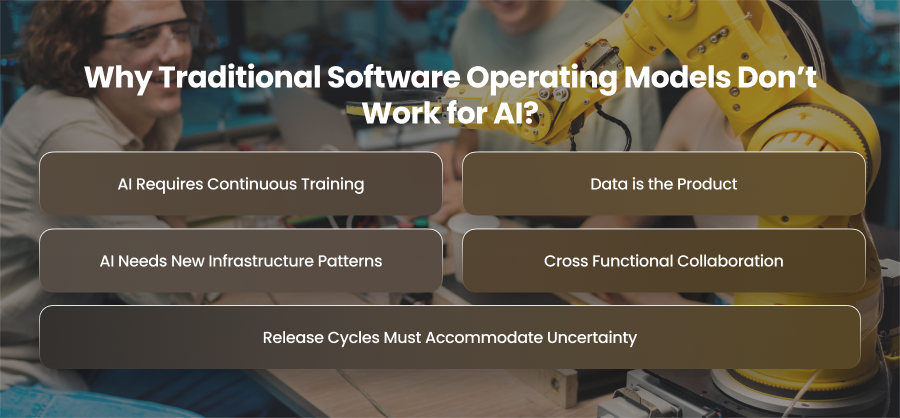
AI Requires Continuous Training
The lifecycle of traditional software development is simple: create the feature, launch it, and then maintain it throughout time. The logic remains unchanged after deployment until a developer modifies the code. AI introduces a fundamentally different lifecycle based on continuous learning.
Also, models degrade as real world behavior shifts. This effect is known as data drift. This means teams cannot simply train a model once. They need ongoing retraining cycles and monitoring systems that detect performance degradation in real time.
Retraining becomes part of routine operations rather than an occasional exercise. Traditional sprint based methods and static release pipelines simply can’t keep up with a system that needs constant recalibration.
Data is the Product
In AI first environments, data is the product. A model’s performance is directly impacted by the consistency and quality of the data. Incomplete or incorrectly classified data will be promptly reflected in the model. This reality demands entirely new processes around data collection and security. Teams must version their datasets just like they version code. They must build pipelines that automatically check for data drift and understand the lifecycle of each dataset.
AI Needs New Infrastructure Patterns
Infrastructure for traditional software focuses on running services and scaling APIs. AI infrastructure introduces an entirely different world of complexity. Instead of simple server based computing, AI requires distributed GPU clusters and vector databases. Moreover, it also demands scalable ETL systems, model registries, and sophisticated observability stacks that measure not only uptime but also model correctness and latency.
Compared to typical DevOps, AI systems have significantly different operational footprints. They require dynamic orchestration based and real time resource allocation to manage GPU intensive tasks. Without rethinking infrastructure, teams find themselves bottlenecked by cloud costs and fragile deployment pathways that can’t support the load or unpredictability of AI workloads.
Cross Functional Collaboration
Traditional software teams can operate effectively in silos. AI disrupts this structure by requiring deep cross functional alignment. Model performance is not just an engineering responsibility; it involves data engineers and domain experts. These groups must collaborate continuously because a change in data can impact model behavior and product outcomes. Without structured collaboration frameworks, teams struggle to diagnose issues or ensure model reliability.
Release Cycles Must Accommodate Uncertainty
Traditional release cycles assume stability. You test the feature and then deploy it. AI releases work more like scientific experiments. A model is deployed, real-world behavior is observed, the training data is modified, and another test is conducted. When interacting with actual consumers, a model that functions effectively in a controlled setting may react quite differently. AI teams must deploy in stages to ensure the model performs safely and effectively before scaling. Release cycles need built in checkpoints for evaluation and rollback mechanisms for model failures.
Foundational Elements of an AI First Operating Model
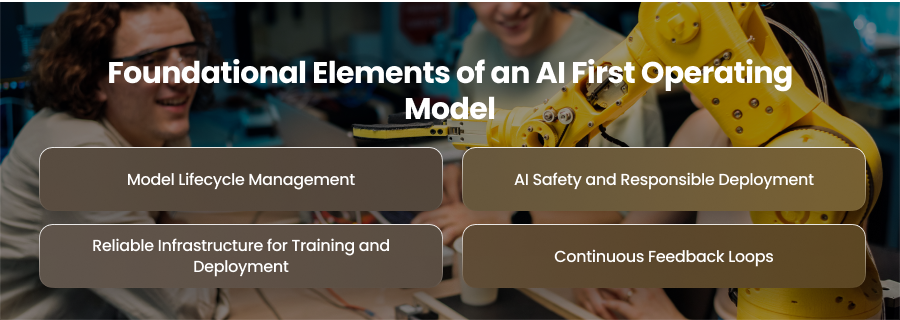
Model Lifecycle Management
AI systems don’t follow the linear and predictable lifecycle of traditional software. Instead, they require continuous feedback loops and iterative optimization. Model lifecycle management becomes a foundational pillar because AI models must be trained and redeployed in a repeating cycle. Organizations need reliable MLOps pipelines that automate these steps and ensure consistency across training runs.
This includes standardized environments and model registries for versioning. It also includes automated evaluation benchmarks and real time monitoring that identifies performance degradation. Moreover, effective lifecycle management also requires clear ownership structures, teams must know who is responsible for model performance and who oversees safety evaluation.
AI Safety and Responsible Deployment
AI brings a new category of risks that traditional software governance cannot manage. This includes biases and harmful outputs. This is why AI first organizations must embed safety and governance into their operating model from day one. Governance frameworks define how models can be trained and how user risk should be evaluated.
Safety guidelines establish the boundaries for model behavior, particularly in high impact AI applications. Processes including humans in the loop are crucial for monitoring important choices and averting unintentional damage. Organizations must also establish systematic red teaming and validation procedures that emphasize testing models against hostile cues or edge case scenarios.
Reliable Infrastructure for Training and Deployment
AI first operating models depend on specialized infrastructure that supports high compute training workloads and continuous monitoring. This includes GPU clusters for training and vector databases for retrieval tasks.
Developing an appropriate observability stack that incorporates drift detection and model correctness in addition to uptime and error rates is equally crucial. Additionally, as AI workloads are infamously costly, cloud infrastructure must be flexible to prevent needless expenditures.
Continuous Feedback Loops
AI systems improve most effectively when they learn from real world usage. That’s why continuous user feedback loops become a foundational part of an AI first operating model. Teams must implement features that capture user reactions, whether explicit feedback or error reports. This data feeds directly into evaluation pipelines and helps identify gaps in model performance and UX friction points.
These insights become the backbone for retraining and prompt optimization. This ensures that the AI product evolves alongside user needs. So, companies that excel at closing this feedback loop move faster and build products that feel truly intelligent rather than unpredictable.
Operating Models for AI First Product & Engineering Teams
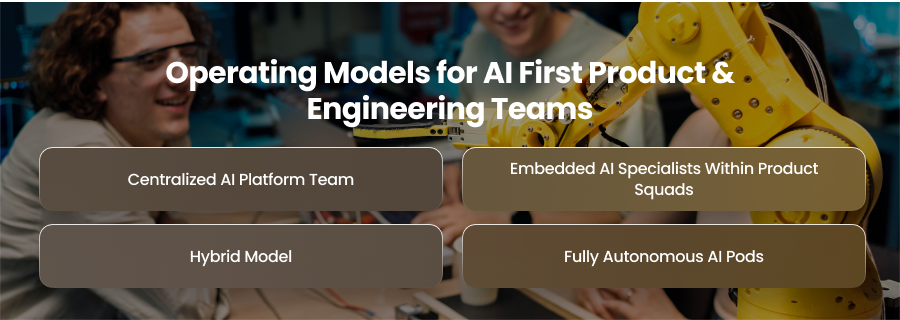
Centralized AI Platform Team
The centralized model creates a dedicated AI platform team responsible for all core infrastructure and governance. This team provides shared services such as feature stores and data pipelines. Also, product teams don’t train models directly from scratch; instead, they utilize APIs or SDKs to integrate AI capabilities into their features.
It provides standardization across teams and reduces duplication of effort. Furthermore, centralized teams also enable economies of scale, particularly for GPU resources and large scale model training.
However, centralization can create bottlenecks for innovation. Product teams can feel constrained by the platform’s pace or capabilities, which can slow iteration cycles. Therefore, organizations must carefully balance platform control with team autonomy to avoid friction.
Embedded AI Specialists Within Product Squads
In this model, AI and ML developers are embedded directly into individual product teams. Each squad becomes responsible for the end to end AI lifecycle for the features they own, and from dataset creation to model deployment and continuous improvement.
Furthermore, it provides deep product context understanding and the ability to tailor AI solutions to specific user needs. Decisions about model design and data quality are made close to the product, leading to faster iterations.
However, this approach can result in inconsistent standard across teams and governance issues. Without strong guidelines, each squad might develop different evaluation metrics and retraining processes.
Hybrid Model
Many mid to large organizations adopt a hybrid hub and spoke model. The centralized hub provides core infrastructure and shared tooling. While the product squads or spokes retain autonomy to develop and deploy models using these shared resources.
This approach combines the benefits of standardization with squad level autonomy. Also, teams move faster without reinventing the pipelines or duplicating effort. The ensures governance and alignment with enterprise wide AI strategies, while the spokes focus on product specific experimentation and deployment.
Fully Autonomous AI Pods
In highly agile AI startups, organizations sometimes form fully autonomous cross functional AI pods. Each pod owns a complete product domain or AI initiative and typically includes a product manager, ML engineers, and domain experts.
Also, pods can quickly experiment with and iterate on models without any delays. However, without shared standards or governance, pods can diverge in methods and infrastructure usage.
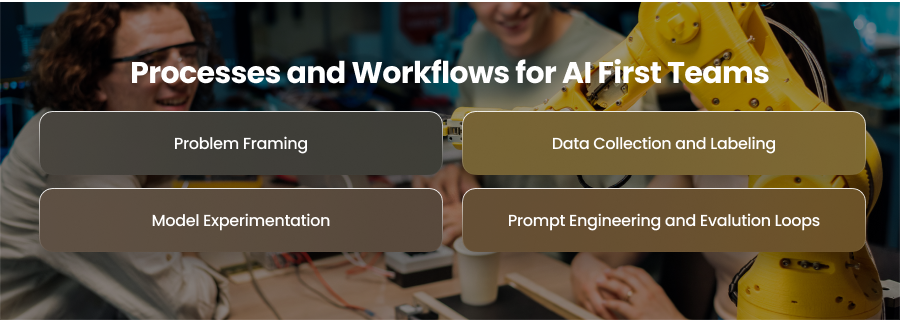
Processes and Workflows for AI First Teams
Problem Framing
AI first workflows begin with defining the problem in a way that is suitable for machine learning. Traditional user stories are no longer enough. Teams need to translate problems into measurable hypotheses, such as improving accuracy or increasing task completion scores.
This shift requires PMs to collaborate closely with ML engineers and data scientists to determine whether the problem is even solvable with AI and what data is needed.
Data Collection and Labeling
AI first team operates like a data organization. Raw data is rarely usable; it must be cleaned and contextualized before models can use it. This process becomes a pipeline rather than a one off task.
Effective workflow includes:
- Iterative data discovery and exploration
- Automated data cleaning and normalization steps
- Structured labeling processes using internal teams or external annotators
- Data governance checks
- Versioning of datasets and features
- Approval workflows before data enters training pipelines
The quality of these pipelines directly influences model performance. Poor data hygiene often leads to hidden biases and brittle models that fail in real world scenarios.
Model Experimentation
AI first teams must experiment much more frequently than traditional product teams. Model development involves running dozens or even hundreds of experiments: different architectures or fine tuning strategies.
High performing teams implement:
- Automated experiment tracking tools
- Shared experiment repositories to avoid duplicating failed trials
- Fast feedback loops with GPU clusters or distributed training
- Model comparison dashboards for accuracy and cost
Prompt Engineering and Evalution Loops
For teams using LLMs, prompt engineering becomes an ongoing workflow. Prompts require versioning and refinement just like code. Changes that appear small can meaningfully impact accuracy or latency.
AI first workflows include:
- Prompt version control systems
- Automated A/B testing of prompt variations
- Structured evaluation datasets to test prompting changes
- Regression checks to ensure newer prompts don’t break older outputs
Final Words
AI first product and engineering teams succeed by embracing new operating models and continuous learning workflows. Also, traditional approaches fall short, but with the right structures, organizations can build scalable and high performing AI systems that change with user needs.