



According to Gartner, 80% of enterprises will have deployed generative AI applications by next year. This is because Gen AI has become the engine powering digital transformation across nearly every industry.
What makes this surge so remarkable isn’t just the number, it’s the speed. Generative AI has progressed from early testing to widespread use in less than two years. Instead of viewing it as a novelty, corporate executives today view it as a fundamental business skill that boosts efficiency and production.
Businesses are using AI in product development cycles and daily activities. Additionally, teams that previously had trouble with manual procedures or information overload now work more quickly and make smarter choices.
We’ll look at why enterprise usage is growing and how businesses are using Generative AI in this guide.
Why is Generative AI Adoption Increasing?
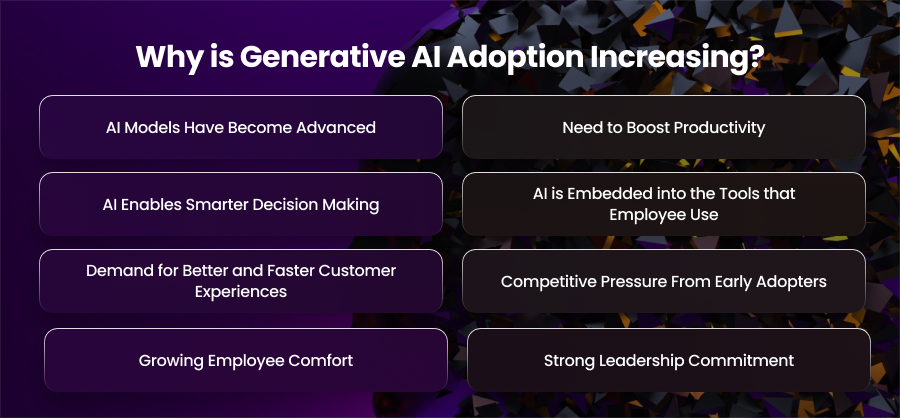
AI Models Have Become Advanced
The development of massive language models and multimodal AI systems has removed the obstacles that previously prevented corporate AI deployment. Large technical teams and intricate infrastructure were needed for early AI technologies.
- Now, businesses can access world class AI models through simple APIs.
- Cloud providers offer pre built AI services.
- Open source models reduce costs and increase customization.
- No code and low code platforms allow non technical teams to build AI workflows.
Because of its accessibility, businesses may now implement effective solutions without requiring in depth AI knowledge. Everyone may now access what was previously exclusive to tech giants.
Need to Boost Productivity
There is a lot of demand on businesses to boost output while keeping expenses under control. Due to economic uncertainty and a shortage of competent people, businesses are looking for more effective ways to operate. Gen AI delivers exactly that. It automates repetitive tasks and speeds up content creation. Furthermore, it supports employees with daily workflows.
AI Enables Smarter Decision Making
Businesses produce enormous volumes of data, but it has traditionally taken a lot of effort and analytical skill to make sense of that data. This is altered by Generative AI, which provides strategic suggestions and instantaneously summarizes complicated information. Leaders are no longer dependent on human interpretation or waiting for comprehensive reports. AI improves the speed and accuracy of decision making throughout the company by providing them with actionable information in real time.
AI is Embedded into the Tools that Employee Use
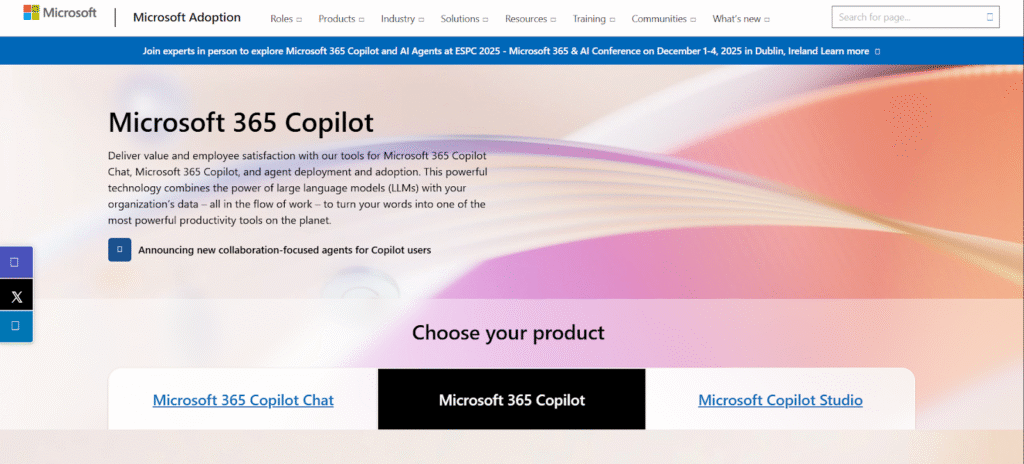
The smooth incorporation of generative AI into business applications is another important factor in acceptance. Tools like Microsoft Copilot are incorporating AI functionality. Employees may utilize AI without switching platforms or implementing new systems, thanks to the elimination of the learning curve.
Demand for Better and Faster Customer Experiences
There has never been a greater level of customer expectations. Customers want quick responses and flawless service. Generative AI helps companies to address these demands by allowing more intelligent chatbots and faster reaction times. AI is used by companies in sectors like banking to boost consumer satisfaction. Adoption of AI becomes necessary rather than discretionary as customer experience becomes a critical differentiator.
Competitive Pressure From Early Adopters
Early generative AI users have openly shown considerable improvements in consumer engagement and speed. Rivals are under pressure to deploy AI in order to remain competitive as a result of these success stories. No business wants to compete with a competitor that can provide better customer service and deliver goods more quickly.
Growing Employee Comfort
As they recognize the benefits of generative AI in streamlining daily chores, employees are growing more at ease with its use. As people see personally how AI enhances their tasks, early worries about complexity or job displacement are progressively receding. With friendly interfaces and embedded tools, employees quickly realize that AI improves efficiency and reduces stress.
Strong Leadership Commitment
Generative AI is no longer seen as an experimental technology but rather as a strategic priority by C-level executives and business leaders. AI appeared in digital transformation agendas and cost optimization plans. With leadership committed, enterprises move more aggressively toward integrating AI across functions.
Common Enterprise Use Cases of Generative AI
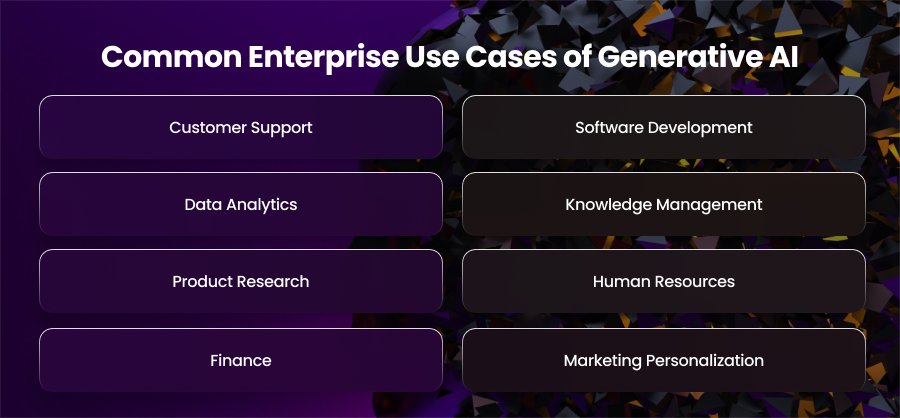
Customer Support
By enabling intelligent chatbots and virtual assistants, generative AI has changed customer service. Simple requests can be handled by these technologies. On the other hand, complex instances can be escalated to human agents if needed. AI may also summarize conversations and provide agents recommendations for a quicker settlement. Businesses that use these solutions frequently see shorter response times and lower support staff operating expenses.
Software Development
In software development, Gen AI is transforming development workflows. AI copilots help AI developers write code and automate testing. Businesses employ AI to lessen the stress on engineering teams and speed up release cycles. IT operations teams utilize AI to monitor and anticipate system problems in addition to development. As a result, improved uptime and quicker resolution of important problems are made possible.
Data Analytics
Businesses can extract insights from large datasets that would otherwise require weeks of analysis thanks to Generative AI. It can also create prediction models and summarize reports. Business leaders rely on AI to improve decision making by providing insightful information rather than utilizing raw data. Consequently, companies are able to make data driven choices with confidence and react quickly to market shifts.
Knowledge Management
Managing internal information between teams and departments is a common challenge for businesses. Document indexing and the creation of searchable knowledge bases are both possible with Generative AI. Without having to go through several files or emails, staff members may easily locate the information they want. Thus, AI frees up people to concentrate on higher value work by optimizing internal procedures and cutting down on time spent on administrative duties.
Product Research
Generative AI is used by research teams to speed up product creation and research. AI is able to forecast consumer preferences and create design prototypes. Teams may therefore explore more creative concepts while reducing the time of experimentation. As a result, businesses that employ AI in their research may be able to maintain their competitive advantage.
Human Resources
AI is increasingly being used in HR to improve hiring. Job descriptions and even onboarding materials may be made with generative AI. These capabilities allow HR teams to concentrate on strategic goals like employee development by improving HR procedures.
Finance
In finance, Gen AI assists with tasks such as regulatory compliance. AI is used by operation teams to automate tedious administrative activities and streamline supply chains. As a result, operations are more nimble and efficient, allowing businesses to react to problems more quickly.
Marketing Personalization
Beyond producing content, generative AI drives highly customized advertising strategies. Therefore, by analyzing customer data, AI generates customized marketing campaigns. Companies are better able to understand customer preferences. This allows marketing teams to create more captivating experiences.
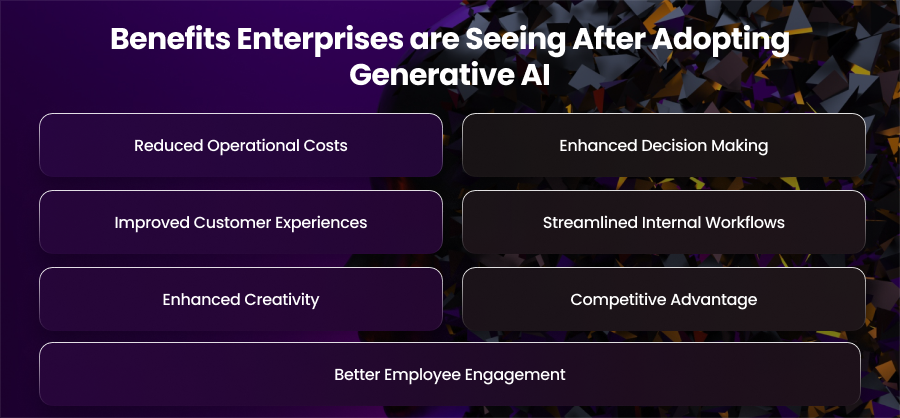
Benefits Enterprises are Seeing After Adopting Generative AI
Reduced Operational Costs
Generative AI enables enterprises to reduce operational expenses across multiple departments. The requirement for human interaction is greatly reduced when regular processes like document preparation and financial reporting are automated. Businesses claim reduced labor expenses and a decreased dependence on outsourcing for routine work.
Enhanced Decision Making
Generative AI has made data driven decision making quicker and more precise. AI assists leaders in making better decisions by evaluating intricate information and offering practical suggestions. For instance, AI may recognize new marketing trends or offer strategic answers that are not immediately obvious. This leads to quicker responses to changes in the market and more astute investments.
Improved Customer Experiences
Generative AI has drastically changed how companies interact with their customers. AI chatbots enable businesses to offer personalized experiences. Customers are constantly active on all channels and receive timely responses to their inquiries. This gives early AI adopters a clear competitive edge by improving customer happiness and loyalty as well as brand perception.
Streamlined Internal Workflows
By streamlining and speeding up routine processes, generative AI has a revolutionary effect on internal operations. AI is effective at tasks like knowledge retrieval and meeting summarizing. This reduces bottlenecks and ensures that teams have more time for decision making and collaboration.
Enhanced Creativity
Generative AI fosters creativity. Marketing teams and product designers use AI generate ideas and explore design variations. AI can also analyze customer behavior and market data to suggest novel solutions that humans might overlook. By combining human insight with AI possibilities, enterprise can experiment faster. This can shorten the product development life cycle.
Competitive Advantage
Successful generative AI adoption gives businesses a distinct competitive advantage. Increasing innovation and simplifying procedures can help businesses stay one step ahead of rivals. Businesses may successfully grow operations. They can also retain agility in a fast paced environment by implementing AI.
Better Employee Engagement
Gen AI frees up workers to concentrate on important work by automating tedious jobs. Instead of being overworked by monotonous chores, team members may take part in high value initiatives, which boosts engagement. Businesses that prioritize using AI often notice increases in staff morale.
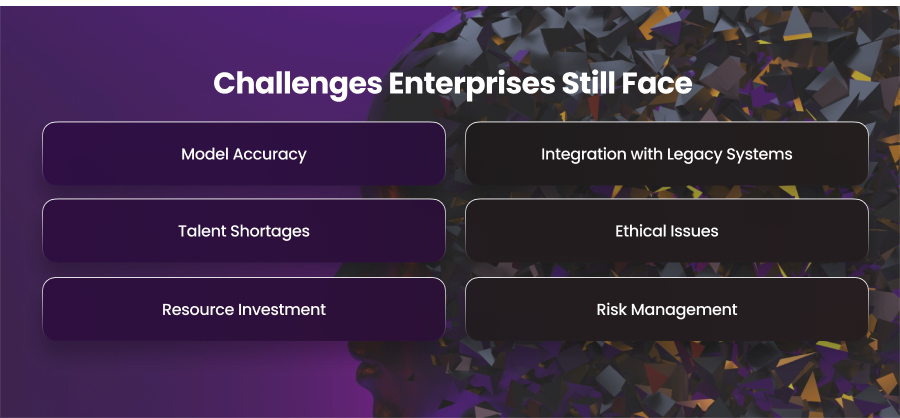
Challenges Enterprises Still Face
Model Accuracy
Although they are strong, generative AI models are not perfect. Hallicution, in which the AI generates outputs that seem convincing but are factually inaccurate, is a frequent problem. Errors in reporting or consumer interactions may result from this. Enterprise must implement rigorous validation processes and human oversight to catch these mistakes. Ensuring accuracy requires proper data management and continuous fine tuning of models to reduce errors and maintain trust in AI generated outputs.
Integration with Legacy Systems
A lot of companies still utilize antiquated IT systems that weren’t designed to accommodate modern AI applications. It might be difficult to integrate generative AI with current ERP systems. Using AI might be challenging due to legacy systems. Moreover, periodically updating antiquated systems are needed to address these issues.
Talent Shortages
Skilled workers are necessary for the successful implementation of AI, yet there is a global scarcity of AI talent. Businesses require specialists in AI governance and planning. Adoption can also be hampered by the fact that many companies find it difficult to develop these skills internally.
Ethical Issues
Companies must address new moral dilemmas created by generative AI. AI may unintentionally introduce bias or generate outcomes that are inappropriate. Organizations must establish clear regulations for the proper usage of AI.
Resource Investment
Implmenting generative AI is not without cost. Enterprise must invest in infrastructure and model fine tuning. Even while AI can eventually yield a large return on investment, smaller businesses may find the initial cost prohibitive.
Risk Management
The risks posed by generative AI must be actively managed by businesses. From erroneous results to the misuse of private information, AI can pose operational and reputational risks. As a result, putting governance structures in place and putting risk-reduction plans into action are crucial. Businesses with inadequate governance may have internal inefficiencies or problems with compliance. Adoption of AI may become less successful overall as a result.
Final Words
Generative AI is transforming enterprises with previously unheard of speed and more sophisticated decision making. Businesses that effectively adapt have a significant competitive advantage despite ongoing problems.