



Research Nester projects that during the next ten years, AI in retail will reach $123.7 billion. This is because AI in retail encompasses more than simply automation. It’s essential to deliver consistent experiences across several touchpoints. Also, gaining a better understanding of consumers can also help.
AI is transforming the retail industry globally, from inventory control to tailored product suggestions.
We’ll go over how AI is changing retail companies and their advantages in this guide. Additionally, we will talk about the difficulties companies have while implementing AI.
Top Use Cases of AI in Retail
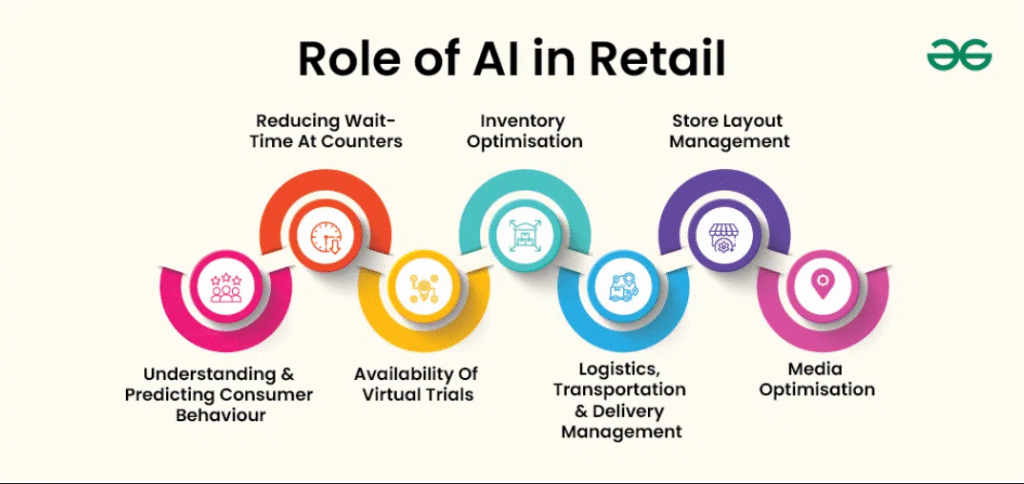
Delivering Hyper Personalized Shopping Experiences
In the retail industry, personalization has emerged as the primary distinction. Customers expect companies to be aware of their habits and preferences makes this possible by analyzing massive amounts of data to create personalized shopping experiences.
Machine learning algorithms fuel recommendation engines that display products that each client is most likely to find interesting. For example, if a consumer often purchases athletic goods, the AI system can automatically offer comparable items, like shoes, or highlight new items in that area.
Transforming Inventory Management
Keeping the proper balance between product availability and storage costs is one of the most difficult tasks in retail. While stockouts result in lost revenue, overstocking wastes resources. To address this problem, AI also makes use of predictive analytics.
AI algorithms can forecast which items will be in demand at particular periods by examining past sales data. As a result, shops are able to optimize stock levels.
For instance, H&M uses AI algorithms to examine trend data and shop receipts in order to determine which clothing designs to carry in certain areas. This reduces unsold inventory while assisting the business in being sensitive to local tastes.
Enhancing Supply Chain
AI is making the supply chain, which is the foundation of retail, smarter and more effective. Manual tracking was a major component of traditional supply chain models. AI solutions, on the other hand, use real time data analysis from logistics partners and suppliers to find inefficiencies and make proactive changes.
AI can optimize delivery routes and allocate resources in a dynamic manner. AI systems, for example, can redirect orders or alert customers in advance if a shipment is delayed due to bad weather. This improves transparency.
Smart Customer Service
For contemporary merchants, chatbots are becoming crucial tools. They assist companies in interacting with customers and responding to inquiries about their products.
Conversations with AI chatbots feel more natural than with traditional customer service techniques because they use natural language processing to comprehend context and intent. They can also get better over time by taking lessons from previous interactions.
Enabling Visual Experiences
Today’s consumers are increasingly using visual and voice based technologies to discover products. AI has made this possible by integrating computer vision and voice recognition into retail platforms.
Users may submit a picture and quickly identify comparable goods using visual search. This is particularly effective in the fashion business, where individual preferences are highly valued. However, by using smart speakers like Alexa to place orders, voice search enables customers to make purchases without using their hands.
Customer Insights
AI is also altering how merchants market their goods and comprehend their target markets. Broad demographics were frequently used in traditional marketing strategies. AI substitutes accuracy for speculation. In order to assist marketers in developing focused programs that yield greater returns on investment, it examines customer behavior and buying intent.
Predictive models may also determine the best price point. This take into account when customers are most likely to make a purchase and which customers are most likely to respond to particular offers. Additionally, sentiment analysis technology keeps an eye on online reviews. This makes it possible for businesses to gauge customer satisfaction.
Benefits of AI in the Retail Industry
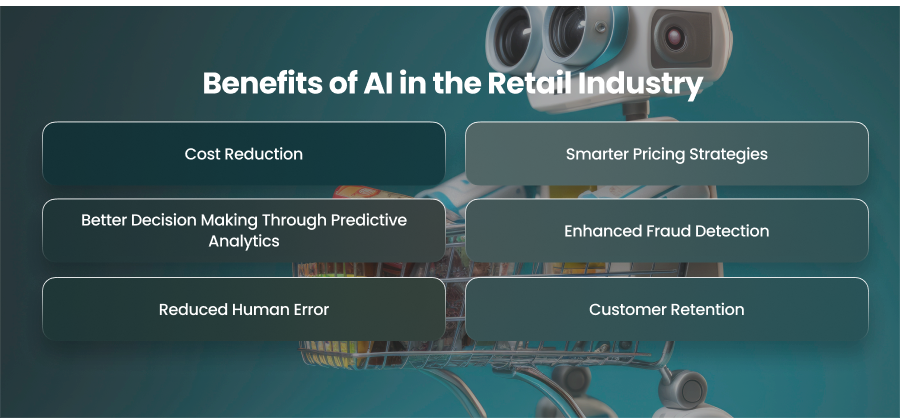
Cost Reduction
By automating time consuming like customer support, AI lowers operating expenses. Retailers may utilize AI solutions to precisely manage complicated activities rather than depending on manual procedures that are prone to human mistakes.
Robotic process automation, for example, may update product catalogs and handle invoices. Additionally, delivery routes can be optimized via AI logistics systems.
Smarter Pricing Strategies
Setting pricing has always required retailers to strike a cautious balance. By enabling dynamic pricing, a tactic in which prices automatically change in response to market conditions, AI solves this issue.
AI algorithms analyze these variables on a regular basis. In order to maximize profits while maintaining consumer pleasure, they establish the ideal pricing.
In a market that is evolving, this degree of price knowledge guarantees that shops stay competitive.
Better Decision Making Through Predictive Analytics
AI gives merchants strong prediction skills that revolutionize decision making. AI can therefore find patterns that people miss by examining enormous information from many sources.
These analytics may be used by retail executives to identify subpar products. For example, predictive analytics can reveal which products are more popular in specific locations or at specific seasons of the year. This enables managers to modify promotions as needed.
Enhanced Fraud Detection
Security is an ongoing problems in retail, particularly in the age of internet transactions. AI helps combat these threats by seeing strange patterns and quickly identifying fraudulent activity. Large volumes of data are analyzed by machine learning algorithms to identify abnormalities that can point to fraud.
For instance, the system may immediately send out a warning or stop the transaction until it is validated if a customer signs in from an unknown area or makes an unexpectedly big purchase. AI can also keep an eye on return requests to identify any fraud.
Thus, AI safeguards customer data. It also prevents financial losses for enterprises by enhancing fraud detection. It also builds trust in digital shopping platforms.
Reduced Human Error
Retail manual operations are frequently prone to errors. By automating intricate computations and offering precise insights, AI reduces these dangers. Moreover, inventory systems powered by AI ensure that stock counts are precise. Also, AI analytics eliminate bias from decision making For instance, instead of relying on intution to decide which product line to expand, AI uses concrete data to predict which products will perform best based on customer demand.
Customer Retention
AI helps businesses build closer relationships with their customers by anticipating their needs and offering pertinent experiences. AI powered loyalty programs are able to determine when a customer is most likely to go and provide them with customized incentives to return.
Additionally, sentiment analysis technologies monitor real time customer comments. This enables brands to deal with problems before they get worse. For instance, AI could see a trend when several customers voice dissatisfaction with a product. This facilitates prompt remedial action by enterprises.
Challenges in Implementing AI in Retail
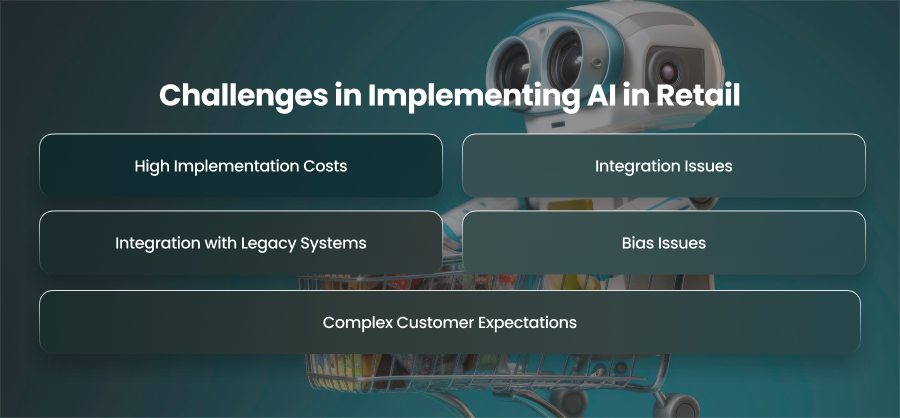
High Implementation Costs
The high cost of using AI technology is one of the main obstacles that organizations must overcome. The development of AI systems requires significant investments in infrastructure.
Retailers often need to purchase or develop new machine learning models and integrate AI into legacy systems. Both of which can be expensive. Budgets may be strained by continuing expenses like maintenance after the first setup.
While big businesses like Walmart can afford to spend millions on AI solutions. However, smaller stores may find it challenging to justify the cost in the absence of guaranteed returns.
Integration Issues
For machine learning algorithms to provide reliable insights, large volumes of clean, pertinent data are needed. Unfortunately, merchants have to deal with erroneous data across departments.
For example, customer information can be stored in CRM tools. Also, you can add supply chain metrics in separate databases. It is a complicated procedure that frequently calls for technological know how to integrate numerous data sources into a single AI system.
Low quality data may also lead to inaccurate findings. Therefore, without proper data governance, even the most advanced AI approaches could not yield meaningful results.
Integration with Legacy Systems
A lot of retail companies use antiquated systems that weren’t made to handle AI. These antiquated systems frequently lack the processing capacity to communicate with contemporary AI technologies.
As a result, integrating AI with such systems may be technically difficult. There are times when a total redesign of the existing infrastructure is required. Installing an AI forecasting tool, for example, may require reorganizing an antiquated ERP system.
Bias Issues
The data utilized to train AI apps determines their objectivity. The AI’s decision will probably reflect any biases in the data. Because AI influences product recommendations, this is particularly troublesome in the retail sector.
Skewed data, for example, might cause an algorithm to unfairly change pricing across regions or recommend certain products only to specific groups of people. Such outcomes can damage a brand’s reputation.
Complex Customer Expectations
Consumers today demand smooth and customized experiences. AI could help achieve this, but using it effectively to meet a variety of customer requirements might be challenging.
If AI systems don’t offer relevant suggestions, customers can become irritated. Additionally, some customers are reluctant to employ AI due to concerns about privacy or a lack of human connection.
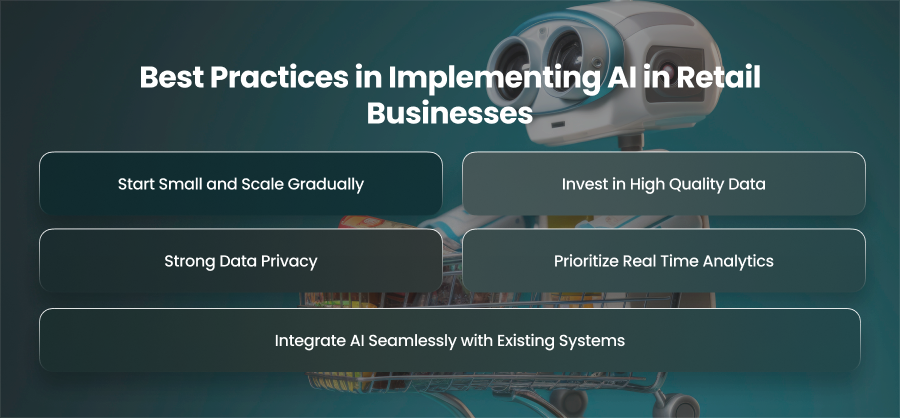
Best Practices in Implementing AI in Retail Businesses
Start Small and Scale Gradually
Instead of a full scale deployment, AI adoption should start with trial initiatives. Before growing, merchants may test algorithms and calculate ROI by starting small. For instance, a shop may first use AI to improve the pricing strategy for a specific product category. The same methodology may be expanded to additional categories after it has been shown to be effective.
Invest in High Quality Data
AI models are not only effective as the data they process. Retailers should concentrate on gathering and preserving high quality data from various sources. Inaccurate forecasts and untrustworthy insights result from poor data quality.
Strong Data Privacy
Large volumes of customer data, including browsing history, are managed by retailers. It is crucial to abide with data privacy rules. Clear consumer consent processes and openness in data collecting foster confidence. Therefore, eliminating bias in algorithms and making sure AI choices serve all consumers equitably are also important aspects of using AI ethically. Additionally, companies that put ethical AI first win customers’ loyalty.
Integrate AI Seamlessly with Existing Systems
AI tools ought to be used in conjunction with current inventory management software and retail systems. Additionally, easy connection minimizes operational disturbances and guarantees uninterrupted data flow. AI systems may be effectively connected to older infrastructures by using middleware and APIs.
Prioritize Real Time Analytics
AI analytics enable quick decision making. For real time data gathering and automation, merchants should concentrate on integrating AI with IoT devices and cloud platforms. Automated stock replenishment systems, for instance, may anticipate spikes in demand and proactively make orders with suppliers.
Final Words
AI is changing the retail sector by increasing efficiency. Even if there are implementation problems, success may be guaranteed by adhering to best practices. Strategic AI adoption by retailers will enhance customer experiences and provide them a major competitive advantage.