


Why AI Body Profiling Matters in Fashion E-Commerce
Online fashion has made product discovery nearly effortless. Fit confidence remains much harder. Shoppers can compare hundreds of products in minutes, yet still struggle to answer the question that matters most before checkout: Will this actually work on my body?
That uncertainty has measurable consequences. Coresight Research estimated that 24.4% of online apparel orders in the United States were returned in 2023. Applied to a $155.8 billion online apparel and footwear market, that represented about $38 billion in returned merchandise and an estimated $25.1 billion in processing costs.
Source: Coresight Research – The True Cost of Apparel Returns
By the Numbers
| Finding | Why It Matters |
|---|---|
| 24.4% average U.S. online apparel return rate | Apparel returns substantially exceed average online return rates. |
| $38B in returned online apparel and footwear | Returns are a major revenue and margin problem, not a niche inconvenience. |
| $25.1B estimated processing costs | Shipping, inspection, restocking, markdowns, and handling create a second cost layer after the lost sale. |
| 70% of apparel returns linked to poor fit or style in one McKinsey survey | Fit and confidence are among the strongest prevention opportunities before checkout. |
| 51% of Gen Z shoppers have bracketed | Ordering multiple sizes or colors with the intention to return most of them has become a digital substitute for the fitting room. |
Sources: Coresight Research; McKinsey & Company; Radial
What Is AI Body Profiling?
AI body profiling is the use of computer vision and statistical modeling to estimate structured body measurements and proportions from digital inputs such as smartphone images. Commercial systems now demonstrate that front-and-side photo capture can produce dozens of standardized measurements without requiring a physical scanner or in-person fitting.
This matters because conventional apparel sizing compresses a complex three-dimensional body into a small number of labels: XS, S, M, L, waist size, inseam, or a brand-specific numeric scale. Body profiling creates a richer data layer that can support more individualized recommendations.
| KEY DISTINCTION: The scan is not the product. The scan creates data. The value comes from what the recommendation system does with that data. |
How Two-Photo Body Measurement Works
Different commercial systems use different proprietary methods, but the high-level workflow is similar. A user follows a guided capture process, typically providing a front-facing image, a side-facing image, and a small set of supporting inputs. Computer vision identifies body landmarks and shape information; statistical models estimate a three-dimensional representation; and the system outputs structured measurements that can be used by downstream applications.
| Stage | What happens | Value to the customer experience |
|---|---|---|
| 1. Guided capture | The user provides front and side images with pose or framing guidance. | Removes the need for a physical scanner or manual tape-measure session. |
| 2. Computer vision | The system identifies body landmarks, silhouette, and proportional information. | Turns images into machine-readable features. |
| 3. Statistical body modeling | The system estimates a 3D representation based on the captured information and trained models. | Creates a consistent body representation for measurement. |
| 4. Measurement output | The system returns structured measurements such as chest, waist, hips, inseam, shoulder width, or other dimensions depending on the implementation. | Provides more detail than a generic size label. |
| 5. Recommendation layer | Body data is compared with product, sizing, creator, or other relevance data. | Transforms measurement data into a useful decision. |
Technical references: 3DLOOK technology overview; Bodygram developer documentation
Why Better Fit Technology Has Become a Business Priority
Retailers have strong incentives to improve fit confidence because many returns are preventable. McKinsey reported that 70% of returns in one apparel-industry survey were caused by poor fit or style. Coresight Research found that U.S. online apparel returns created billions of dollars in processing costs before merchandise waste was even considered.
Consumers respond to that uncertainty with workarounds. Radial reports that 51% of Gen Z shoppers have engaged in bracketing – buying multiple sizes or colors of an item with the intention of returning all but one. In effect, the customer’s home becomes the fitting room, while the retailer inherits the reverse-logistics cost.
| THE BETTER SOLUTION IS UPSTREAM: Making returns harder addresses the symptom. Helping consumers make more confident decisions addresses the cause. Fit technology creates value when it reduces uncertainty before checkout, not when it simply adds another step after the purchase. |
Body Measurements Improve Recommendations, But They Are Only One Signal
Body data can answer important fit questions, but a shopper is more than a set of measurements. Two people with nearly identical proportions may have completely different tastes, budgets, professions, climates, cultural influences, and reasons for shopping.
That is why the strongest recommendation systems combine physical similarity with other relevance signals. Depending on the use case, those signals may include:
- Style and aesthetic preferences
- Lifestyle and profession
- Climate and geography
- Budget and brand preferences
- Creator engagement
- Purchase and return behavior
- Language or cultural interests
- Customer-defined priorities and current intent
In UBU’s implementation, a two-photo scan produces a profile using 33 body measurement points. Those measurements can then contribute to a similarity score between consumers and creators. But the goal is not to find a physical duplicate. The goal is to combine body relevance with the characteristics the consumer says matter for that particular shopping decision.
| DESIGN INSIGHT: Measurements can improve fit relevance. Customer intent explains what relevance means today. The strongest personalization systems use both. |
Virtual Fitting Rooms Validate the Need, But They Do Not Solve the Entire Problem
The expansion of virtual try-on, digital avatars, fit finders, and retailer-specific sizing tools validates a basic market truth: shoppers want more personalized information before they buy. Major retailers and fashion platforms have invested in technology designed to improve confidence around fit and visualization, and early case studies report lower returns and higher conversion on products where those tools are used.
The limitation is structural. Most fit tools still live inside one retailer or one technology ecosystem. A shopper may provide measurements or create an avatar for one shopping experience, then begin again somewhere else. The personalization works, but only inside that boundary.
Cross-retailer approaches are beginning to emerge, which is important because it proves the concept is technically possible. Vogue Business reported on avatar technologies that allow consumers to reuse a digital profile across participating retailers. But this remains far from the default shopping experience.
Source: Vogue Business – Want to reduce returns? Avatars might be the answer
Retailer-Centered vs. Consumer-Centered Personalization
| Retailer-centered personalization | Consumer-centered personalization |
|---|---|
| Built for one retailer or catalog | Designed around a reusable consumer profile |
| Setup may repeat across brands | Profile can be reused with permission |
| Fit insight ends at the retailer boundary | Body and preference data can support broader discovery |
| Retailer defines available recommendations | Consumer can help define which characteristics matter |
| Optimizes one shopping destination | Can connect creators, products, and multiple retailers |
This is the larger opportunity: moving from a retailer asking, ‘How can I understand this shopper inside my store?’ to a consumer saying, ‘I already have a profile. Let me use it wherever it creates value.’
Founder Perspective: Start With the Consumer, Not the Catalog
UBU approached fit from a different starting point. The original insight was not that every retailer needed a better size tool. It was that consumers needed a place where relevance could travel with them.
As a petite shopper, I first saw the value simply by finding a creator who was close to my height. I kept returning to her content because I could immediately understand how proportions might translate to me. The obvious next question was: what if I could build that relevance into the shopping experience instead of manually searching for it every time?
Body profiling added a structured fit layer. Creator matching added lived context. Cross-retailer discovery expanded the usefulness beyond a single catalog. And customer-defined preferences allowed the shopper to decide what similarities mattered – body proportions for one purchase, professional style for another, cultural fashion for another.
| FOUNDER INSIGHT: The measurement is data. The advantage comes from combining that data with relevance, intent, and access across the broader shopping journey. |
The Architecture of Consumer-Centered Fit Personalization
| 1 Two user-provided images | 2 Structured body profile | 3 Matching + recommendation layer | 4 Relevant creators | 5 Products across retailers |
| CORE IDEA: The measurement is data. The value comes from what the system does with it. |
Business Benefits of AI Body Profiling
| Stakeholder | Potential benefit | What creates the value |
|---|---|---|
| Consumers | Greater fit confidence and less time spent comparing sizes | More relevant body and creator references before checkout |
| Retailers | Higher-quality conversion and fewer avoidable returns | Better decision support before the order is placed |
| Creators | More relevant audiences | Consumers can find creators whose proportions and experiences are useful to the decision |
| Operations | Lower reverse-logistics pressure | Fewer unnecessary multi-size orders and returns |
| Sustainability | Fewer avoidable shipments and less processing waste | More purchases are correct the first time |
Limitations and Responsible Design Considerations
AI body profiling is useful decision support, not a guarantee of fit. Product teams should be explicit about that limitation. Garment construction, fabric stretch, intended silhouette, brand-specific grading, manufacturing variance, and personal fit preferences can all affect whether a product feels right even when body measurements are accurate.
1. Privacy and consent
Body images and measurement data are sensitive. Systems should minimize collection, explain why data is needed, define how long it is retained, and give users meaningful control over deletion and reuse. Depending on the technology and jurisdiction, biometric and privacy requirements may also apply, so legal review should be built into product design rather than added later.
2. Accuracy and uncertainty
Measurement systems should be tested against the actual use case. A model that is sufficiently accurate for recommendation may not meet the evidence standard required for medical or safety-critical decisions. Product claims should match validated performance.
3. Bias and representation
Training and validation data should represent the range of bodies the system will serve. NIST’s AI Risk Management Framework emphasizes validity, transparency, privacy enhancement, and fairness, with harmful bias managed as core characteristics of trustworthy AI.
Reference: NIST AI Risk Management Framework
4. Personalization without pigeonholing
A body profile should expand options, not trap customers inside assumptions. Users should be able to change which characteristics matter, explore outside their usual patterns, and correct recommendations that do not reflect their preferences.
5. Explainability
Where possible, systems should tell users why a recommendation is being made – for example, similar proportions, preferred fit, or stated style priorities. Explainability can turn a prediction into a decision aid.
Best Practices for Product Teams
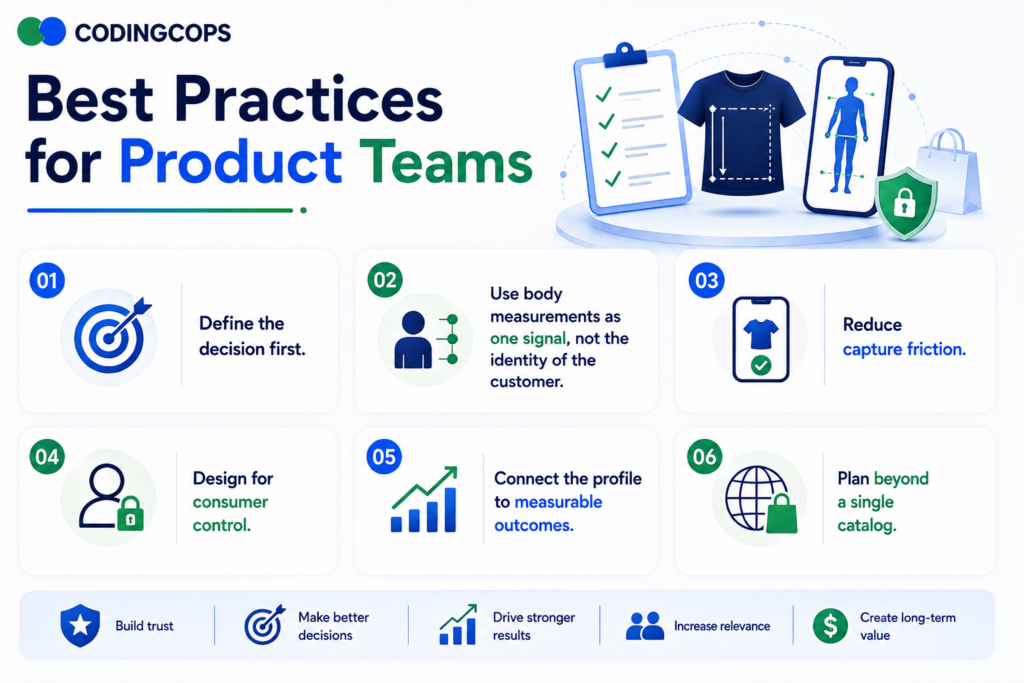
1. Define the decision first.
Be precise about whether the product is helping a shopper choose a size, find a relevant creator, compare silhouettes, or reduce search time. Different decisions require different data.
2. Use body measurements as one signal, not the identity of the customer.
Fit data is powerful when combined with style, context, and customer-defined intent.
3. Reduce capture friction.
Guided smartphone capture, clear instructions, validation, and fast processing are essential because an accurate system has little value if customers abandon setup.
4. Design for consumer control.
Explain what is collected, let users update their profile, and make consent and deletion understandable.
5. Connect the profile to measurable outcomes.
Track recommendation acceptance, confidence, time saved, conversion, return reasons, and repeat use – not just scan completion.
6. Plan beyond a single catalog.
Even if the first implementation is retailer-specific, consider whether the architecture could eventually support reusable consumer context across brands and channels.
What Comes Next for AI Body Profiling?
The technology is moving from isolated fit tools toward broader personalization systems. Three trends are especially important:
- Fit will become one signal inside richer recommendation systems, rather than a standalone feature.
- Consumer-controlled profiles will become more valuable as shoppers expect to reuse context across brands and platforms.
- Human creator content will remain important because body similarity can improve relevance, but lived experience, styling, taste, and trust still come from people.
This is where Article 2 connects back to the larger series: AI is not valuable because it knows someone’s measurements. It is valuable because it can use those measurements to reduce friction and connect the consumer with better information at the moment of decision.
Conclusion
AI body profiling addresses one of fashion e-commerce’s most persistent problems: shoppers are asked to make fit decisions without enough information. Two-photo body measurement can turn an ordinary smartphone into a source of structured fit data, but the scan itself is only the beginning.
The larger opportunity is to combine body data with product information, creator relevance, customer behavior, and explicit intent – then make that personalization useful across more of the shopping journey. Retailer-specific fitting tools have already validated demand. Consumer-centered personalization expands the idea by asking what happens when the profile belongs to the shopper rather than the store.
That shift can create value for everyone involved: more confidence and less time for consumers, better-quality transactions for retailers, more relevant audiences for creators, and fewer avoidable returns for the broader system.
| FINAL TAKEAWAY: Better fit technology is not ultimately about measuring bodies more precisely. It is about helping people make better decisions with less uncertainty. |