




Artificial intelligence is changing social commerce by shifting discovery from popularity to personalization. Instead of showing every shopper the creators with the largest audiences, AI-powered platforms can connect consumers with people, products, and recommendations that better reflect their body type, style, lifestyle, culture, values, and immediate goals.
The timing matters. Grand View Research valued the global social commerce market at $1.48 trillion in 2025 and projects it to reach approximately $1.93 trillion in 2026, growing at a compound annual rate of 37.4% through 2033. As the market expands, the challenge is no longer helping consumers discover more products. It is helping them discover the right products through the right people with greater confidence and less effort.
Source: Grand View Research, Social Commerce Market.
| Core thesis: For years, success in social commerce was measured by popularity. The next generation will be measured by relevance. AI is shifting creator commerce from audience size to audience quality. |
Social Commerce by the Numbers
Sources: Grand View Research; Baymard Institute; 3DLOOK apparel returns analysis; Deloitte.
What Is AI-Powered Social Commerce?
AI-powered social commerce uses artificial intelligence to personalize how consumers discover products, creators, reviews, and shopping content within socially driven digital experiences. It combines technologies such as recommendation engines, machine learning, computer vision, and behavioral analytics with information customers intentionally choose to provide.
Traditional social commerce relies heavily on popularity signals such as follower counts, views, likes, and aggregate engagement. AI-powered social commerce can consider a richer set of signals, including:
- Product and creator engagement
- Purchase and browsing behavior
- Style and aesthetic preferences
- Budget, climate, and lifestyle
- Language and cultural interests
- Customer-defined values and goals
- Body measurements and proportions, when voluntarily provided
The goal is not simply to predict which product will receive another click. It is to determine which information will help a particular person make a better decision.
Why Traditional Social Commerce Is Reaching Its Limits
Consumers have access to more creators, products, reviews, and shopping content than ever before. That abundance improves discovery, but it also creates new friction. Shoppers still have to answer questions such as:
- Will this fit me?
- Will it look the same on someone with my proportions?
- Does this creator’s recommendation apply to my lifestyle?
- Can I trust this review?
- How long will it take to compare all these options?
- Am I making the right decision?
Baymard Institute reports an average online cart abandonment rate of 70.19%. Not every abandoned cart is caused by poor personalization, but the figure shows how much friction remains even after a consumer has found a product and expressed enough interest to add it to a cart.
Source: Baymard Institute.
| Key takeaway: Social commerce has largely solved the problem of access. AI can help solve the problem of relevance. |
How AI Is Transforming Social Commerce
AI Recommendation Engines
Recommendation engines evaluate products, creators, content, and customer signals to rank the options most relevant to an individual. Traditional systems often rely heavily on past behavior: what a shopper clicked, purchased, searched for, or watched.
Those signals remain valuable, but they describe where someone has already been. They do not always reveal what matters to that person now. Modern systems can combine behavioral history with customer-defined intent, for example, a preference for eco-friendly products, creators connected to a particular culture or country, content in a specific language, or clothing suited to a new professional role.
| Behavior + intent: Behavior tells the system what a customer has done. Intent tells the system where the customer is trying to go. |
AI Body Profiling and Computer Vision
AI body profiling can convert two user-provided photographs, one from the front and one from the side, into dozens of structured body measurements and proportional data points. With clear consent, those measurements can become one input into a broader recommendation system.
Rather than relying only on a conventional size label, a platform can evaluate similarities between a consumer and creators with comparable proportions. Body data alone is not the full solution. Its value increases when combined with style, budget, climate, lifestyle, culture, creator affinity, and other preferences the consumer chooses to define.
That combination helps address two persistent questions in fashion commerce:
Will it fit me? • Will it look right on someone built like me?
Machine Learning and Behavioral Feedback
Machine learning identifies patterns across saves, clicks, purchases, dismissed recommendations, creator engagement, and returns. Over time, those signals can improve relevance. The strongest systems use behavioral data to complement, not override, the preferences customers intentionally provide.
AI Orchestration
No single technology creates an intelligent shopping experience by itself. Computer vision creates structured visual data. Machine learning recognizes patterns. Recommendation engines rank relevance. Customer input communicates goals and values. Behavioral feedback improves future results. Cloud infrastructure connects these components and delivers the experience at scale.
| Technical insight: The value does not come from one model. It comes from how multiple capabilities are orchestrated around the customer’s problem. |
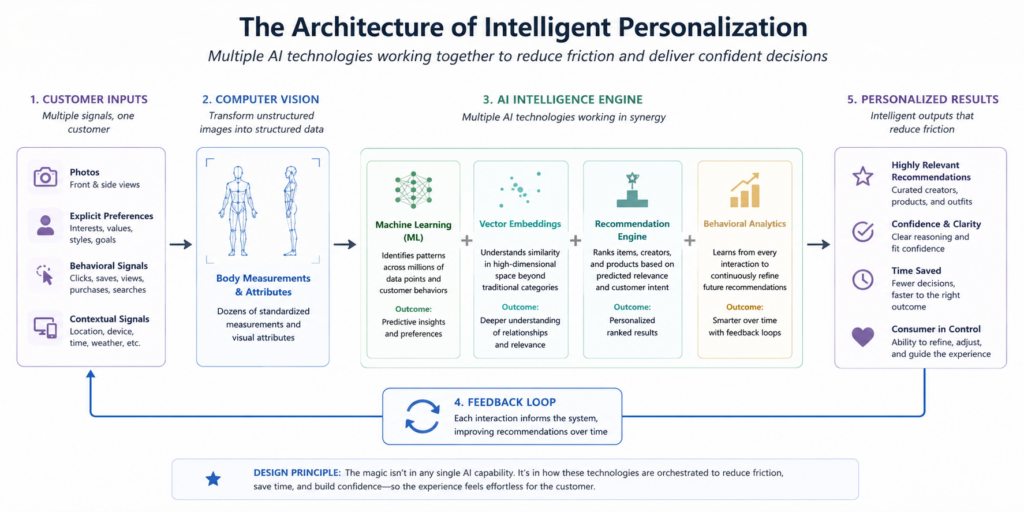
Figure 1. The architecture of intelligent personalization combines customer inputs, computer vision, machine learning, recommendation systems, and continuous feedback.
Founder Perspective: Why Relevance Matters
The idea behind UBU began with an ordinary shopping experience. I am 5’1″. When I found a fashion creator who shared my height and similar proportions, shopping became dramatically easier. For the first time, I did not have to mentally translate how a pair of jeans or a jacket shown on a much taller model might look on me. I could see it.
I began returning to that creator’s profile whenever I needed something specific, not because she was the most popular person in my feed, but because her experience was relevant to mine. That observation led to a broader question:
What if social commerce were organized around relevance rather than popularity?
The idea expanded beyond body type. People may want to connect through shared style, profession, culture, language, climate, life stage, interests, values, or goals. Personalization is not about restricting people to creators who are identical to them. It is about helping them define which similarities matter for a particular decision.
Later conversations validated that the need extended beyond my own experience. One Asian American intern described growing up without seeing many fashion creators who reflected her identity or cultural perspective. Her story showed how representation can influence not only what consumers purchase, but how they see themselves.
A member of our engineering team, who is nearly 6’5″, had a different reaction. Shopping was not something he considered a particular frustration; he rarely thought about it. After hearing the concept, however, he immediately recognized its value. Before a conference or presentation, he could browse professional men with similar proportions, find a complete outfit curated by someone relevant to him, purchase the individual pieces, and finish the task on his own schedule.
The product solved a problem he had never formally identified: he did not want to shop more. He wanted to spend less time shopping while feeling more confident in the outcome.
| Founder insight: The best AI products often solve problems customers did not realize technology could solve—then make the solution feel obvious in hindsight. |
The Business Cost of Fashion Returns
Fashion demonstrates why better personalization matters operationally as well as emotionally. Industry research summarized by 3DLOOK reports that the average U.S. clothing return rate is approximately 20.8%, while online fashion return rates are frequently cited around 30% and can reach 40% to 50% in some categories or peak periods.
Sources: 3DLOOK apparel return statistics and 3DLOOK fashion e-commerce statistics.
The primary issue is often uncertainty about fit and sizing. Research summarized by 3DLOOK and Coresight Research found that size and fit were the leading reason for apparel returns among surveyed retailers. This uncertainty also drives bracketing—the practice of ordering several sizes or colors with the intention of returning most of them.
Source: Radial, Online Fashion Retailer’s Guide to Reducing Returns.
Returns do not simply reverse a transaction. They create an entirely new supply chain. Returned apparel may need to be:
- Transported through a reverse-logistics network
- Opened and individually inspected
- Checked for odors, stains, hair, wear, damage, or missing tags
- Cleaned, steamed, repackaged, and relabeled
- Re-entered into inventory
- Discounted, liquidated, donated, recycled, or discarded when resale is no longer economical
Coresight Research, in analysis summarized by 3DLOOK, estimated that a 24.4% online apparel return rate represented approximately $38 billion in returned merchandise and more than $25 billion in processing costs for U.S. apparel retailers.
Source: 3DLOOK / Coresight Research, True Cost of Apparel Returns.
| The Opportunity Is Upstream Making returns harder addresses the symptom. Helping consumers make more confident decisions addresses the cause. AI can reduce uncertainty before checkout by improving fit, relevance, and product discovery—benefiting the shopper and the retailer at the same time. |
Better personalization will not eliminate returns. Products can arrive damaged, differ from their online appearance, or fail to meet quality expectations. But helping consumers evaluate fit, proportion, style, and relevance before purchasing can reduce avoidable returns and practices such as bracketing.
The most sustainable purchase is often the one that does not have to be returned.
Why Virtual Fitting Rooms Are Only Part of the Solution
The growth of virtual try-on and fit technology confirms that retailers recognize a major source of friction in online fashion: consumers want more confidence before they purchase. Industry surveys summarized by 3DLOOK indicate that many apparel brands already use or plan to implement virtual try-on technology.
However, most existing solutions remain retailer-specific. A shopper may create a profile, provide measurements, or complete a virtual fitting experience for one brand, only to repeat the entire process when visiting another. The technology improves personalization inside that retailer’s ecosystem, but the customer still has to start over elsewhere.
That limitation exposes a broader opportunity: move the profile from the retailer to the consumer. Instead of asking every retailer to build a separate understanding of the same person, a centralized platform can allow the consumer to create one body and preference profile and use it subject to their control and consent across multiple retailers, creators, and shopping experiences.
| Retailer-Specific Personalization | Consumer-Centered Personalization |
|---|---|
| Built for one retailer | Designed to work across retailers |
| Customer repeats setup | Customer creates one reusable profile |
| Recommendations limited to one catalog | Discovery can span multiple brands |
| Retailer controls the experience | Consumer helps control the experience |
| Solves fit within one store | Reduces friction across the shopping journey |
This was one of the central ideas behind UBU. Rather than building another retailer-specific fitting tool, we approached the problem from the consumer’s perspective. A body profile generated from two user-provided images becomes one input into a broader matching system. It can be combined with style, lifestyle, cultural interests, budget, language, creator preferences, and other characteristics the consumer chooses to define.
The result is not simply a more accurate size recommendation. It is a centralized platform where consumers can discover relevant creators and shop across multiple retailers without rebuilding their identity every time they visit a new store.
| Strategic distinction: Virtual fitting rooms validate the need for personalized measurements. The next step is making that personalization useful beyond a single retailer. |
Benefits of AI Personalization in Social Commerce
Benefits for Consumers
- Discover relevant products faster
- See items modeled by creators with comparable proportions
- Make purchases with greater confidence
- Reduce time spent searching and comparing
- Express personal preferences rather than relying solely on algorithmic assumptions
- Find creators who reflect their culture, language, lifestyle, or values
- Reduce the likelihood of buying multiple options simply to determine what works
Benefits for Creators: Purchase-Ready Followers
Traditional social media rewards creators for building the largest audience possible. AI-powered creator commerce changes that equation by prioritizing audience quality.
At UBU, we use the term purchase-ready followers to describe consumers who have both a strong relevance match with a creator’s niche and genuine purchase intent. These followers differ from curiosity followers, who primarily browse for entertainment, and vanity followers, who increase an audience count but rarely create measurable commercial value.
A smaller, highly relevant audience may produce stronger engagement, more conversions, and more sustainable affiliate revenue than a much larger passive following. Deloitte reports that 9 in 10 consumers trust creators they follow as information sources, and about half say user-generated content such as reviews makes them more likely to purchase on a social platform.
Source: Deloitte, Driving Resilience and Revenue Through Social Investments.
| Creator-economy shift: AI is shifting creator commerce from audience size to audience quality. |
| Traditional Creator Economy | AI-Personalized Creator Commerce |
|---|---|
| Followers | Purchase-ready followers |
| Reach | Relevance |
| Impressions | Purchase intent |
| Viral exposure | Trusted recommendations |
| Audience size | Audience quality |
| Broad distribution | Precision matching |
| Engagement metrics | Commercial outcomes |
Benefits for Retailers
- Greater purchase confidence and higher-quality conversions
- Better creator-to-customer matching
- More useful first-party customer data
- Lower search and decision friction
- Reduced avoidable returns and bracketing
- Stronger retention and customer loyalty
- More efficient creator partnerships and attribution
Benefits for Sustainability
More accurate recommendations can reduce unnecessary shipments, reverse-logistics transportation, inspection and repackaging requirements, markdowns, liquidation, and products discarded because resale is no longer economical. This aligns customer experience, retailer profitability, and environmental value around the same objective: helping the customer make a better decision the first time.
Why Human Creators Still Matter
AI can process millions of data points, identify patterns, and determine which creators may be most relevant to a consumer. It cannot replace lived experience. Creators know how to curate an outfit, furnish a living room, build a skincare routine, dress for a professional event, or explain how a product performed in daily life.
- Taste
- Creativity
- Context
- Experience
- Storytelling
- Authenticity
- Trust
AI should not attempt to manufacture those qualities. It should help the right people find them.
AI curates relevance. Humans curate taste.
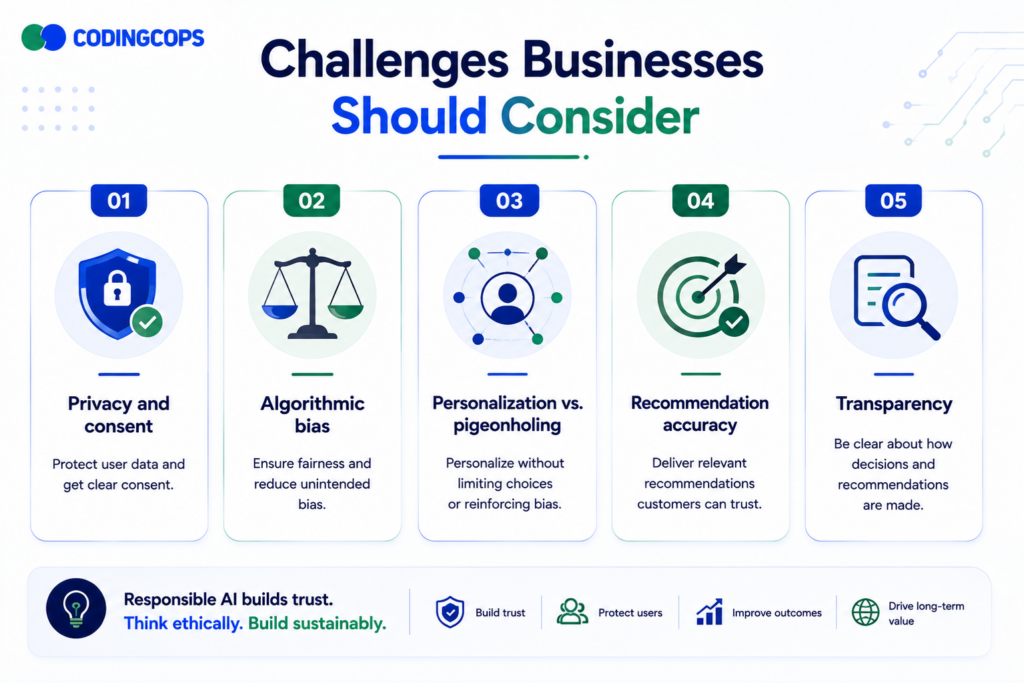
Challenges Businesses Should Consider

Privacy and consent
Body measurements, purchasing histories, cultural interests, and lifestyle preferences can be sensitive. Businesses should collect only what is needed, explain how it will be used, and obtain meaningful consent.
Algorithmic bias
Models trained on incomplete or unrepresentative data can reproduce narrow standards or deliver less accurate recommendations to underrepresented groups. Systems require diverse data and ongoing testing.
Personalization vs. pigeonholing
Personalization should expand discovery, not confine people to assumptions. Customers should control which characteristics matter and when.
Recommendation accuracy
AI recommendations are probabilistic, not guaranteed. Measurements, preferences, and product sizing can change. Limitations should be communicated clearly.
Transparency
Consumers should understand why a recommendation appears and be able to correct inaccurate assumptions. Trust grows when personalization feels collaborative rather than hidden.
Best Practices for AI-Powered Social Commerce
1. Begin with a specific customer problem: Identify the exact friction the system should reduce fit uncertainty, endless searching, irrelevant creator feeds, or repeated onboarding.
2. Combine behavioral data with customer intent: Clicks and purchases provide useful signals, but customers should also be able to state what matters to them now.
3. Measure confidence and time saved: Conversion and engagement matter, but product teams should also evaluate whether the experience helped customers decide faster and feel more certain.
4. Use AI to amplify human expertise: Let AI handle pattern recognition, scale, and matching. Preserve human creativity, taste, judgment, and storytelling.
5. Build for transparency and control: Explain recommendations, allow customers to update preferences, and make consent easy to understand and manage.
The Future of AI in Social Commerce
The next phase of social commerce will combine more sophisticated creator-to-consumer matching, AI body profiling, conversational shopping assistants, virtual try-on experiences, customer-defined preference profiles, cross-retailer personalization, and better attribution between creators and purchases.
The most important shift will be from retailer-owned personalization toward consumer-centered personalization. A consumer-controlled body and preference profile could eventually help shoppers move across multiple retailers, brands, and creator communities with their consent.
That is the difference between personalization as a retailer feature and personalization as customer infrastructure.
Conclusion
Social commerce has always been built on connection. Artificial intelligence is not changing that; it is making those connections more relevant.
The future will not belong only to the platforms with the most creators, the largest catalogs, or the loudest influencers. It will belong to those that help consumers discover the right products through the right people at the right moment.
For consumers, that means greater confidence and less time spent searching. For creators, it means access to higher-quality, purchase-ready audiences. For retailers, it means better transactions, stronger relationships, and fewer avoidable returns.
Popularity helped build social commerce. Personalization will define its future.
The next evolution of social commerce is not about helping creators reach more people. It is about helping the right people find the right creators.