




Hero Introduction
Offshore staffing has become a major growth strategy for businesses. Companies are no longer hiring globally just to reduce costs. They are building offshore teams to access specialized talent, scale faster, improve operational flexibility, and stay competitive in fast-moving markets.
As remote work and distributed collaboration continue to evolve, offshore employment is becoming a long-term workforce solution for startups, enterprises, and growing tech companies alike.
Executive Summary
Offshore employment is reshaping how modern businesses hire and scale. Companies are using offshore staffing to solve talent shortages, accelerate growth, and reduce operational costs while maintaining productivity.
This blog explores why offshore staffing is growing rapidly, the latest offshore employment trends, average hiring costs across regions, and the best practices businesses should follow to build successful offshore teams.
Why Offshore Staffing is Growing Rapidly?
Offshore employment is growing faster than ever as businesses face increasing pressure to scale efficiently, reduce operational costs, and compete in global markets. What was once viewed primarily as a cost-cutting strategy has now become a core business growth model across industries.
Companies are no longer limiting offshore hiring to basic support functions. Now, organizations are building highly skilled offshore teams for software development, AI engineering, cybersecurity, and customer experience management.
Access to Global Talent Pools
One of the biggest reasons for offshore staffing growth is the worldwide shortage of skilled professionals. Many local hiring markets are extremely competitive, especially in industries like software development, cloud computing, data science, cybersecurity, and AI.
Businesses often struggle to find qualified candidates locally within reasonable timelines and budgets. Offshore staffing allows companies to access talent from global markets where skilled professionals are more readily available.
Instead of competing for a limited number of local candidates, organizations can hire from international talent hubs with large pools of experienced professionals. This gives businesses greater flexibility in finding the right expertise for their projects.
Companies also benefit from access to niche skill sets that may be difficult to source domestically. Specialized developers, DevOps engineers, UI/UX designers, and multilingual customer support teams are now commonly hired offshore.
Rising Local Hiring Costs
Hiring costs continue to increase in major business markets such as the USA. Salaries, benefits, taxes, office space, insurance, and recruitment expenses can place enormous pressure on business budgets.
For startups and scaling businesses, building large in-house teams locally may not always be financially sustainable. Offshore staffing offers a more cost-efficient alternative without sacrificing productivity or technical expertise.
Businesses can often reduce operational expenses significantly by hiring offshore employees in regions with lower labor costs. These savings can be reinvested into:
- Product development
- Marketing initiatives
- Business expansion
- Research and innovation
- Customer acquisition
Cost optimization remains important, but companies are now balancing affordability with quality, communication skills, and long-term stability.
Remote Work Has Normalized Global Collaboration
The global shift toward remote work permanently changed how businesses operate. Distributed teams are now common across industries, making offshore staffing far easier and more practical than before.
Companies have become comfortable managing remote employees using:
- Video conferencing problems
- Cloud collaboration tools
- Project management systems
- Shared development environments
- Real-time communication platforms
This digital infrastructure has removed many of the barriers that once made offshore collaboration difficult. Businesses can now integrate offshore employees into daily operations almost as seamlessly as local teams.
Remote-first workplace cultures have also improved employee acceptance of distributed team structures. Offshore workers are increasingly viewed as integrated team members rather than external resources.
Faster Hiring and Scalability
Speed has become a major competitive advantage in modern business environments. Companies need to launch products faster, scale operations quickly, and respond quickly to market changes.
Traditional local hiring processes can take months due to lengthy recruitment cycles and onboarding delays. Offshore staffing helps businesses scale faster by providing quicker access to pre-vetted professionals.
Many offshore staffing providers already maintain talent pipelines, allowing businesses to fill positions within days or weeks instead of months. This speed is especially valuable for:
- Startups preparing for product launches
- SaaS companies scaling engineering teams
- Enterprises managing large transformation projects
- Business handling seasonal demand spikes
The ability to rapidly expand or reduce team sizes also gives organizations greater operational flexibility.
Demand for Specialized Technical Expertise
Modern businesses increasingly rely on advanced technologies that require highly specialized expertise. Areas like AI, blockchain, cloud architecture, machine learning, and cybersecurity are experiencing explosive growth.
Unfortunately, local talent availability often cannot keep pace with this demand. Offshore staffing allows businesses to tap into global technology ecosystems where these specialized skills are more accessible.
Top Offshore Employment Trends in 2026
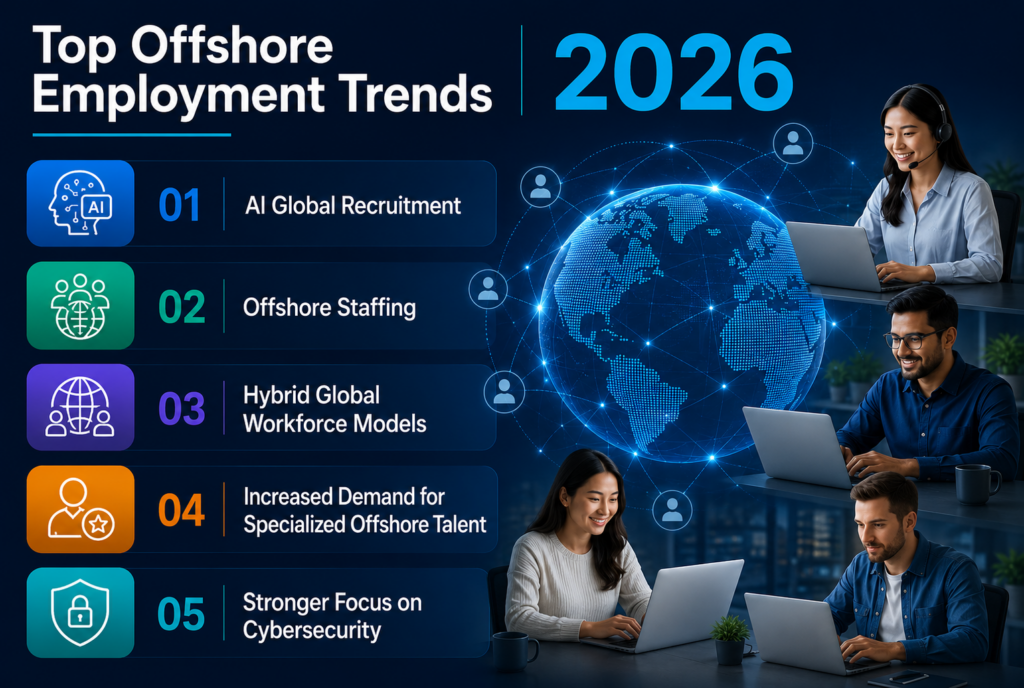
Offshore employment is evolving rapidly as businesses move beyond traditional outsourcing models and adopt more strategic global workforce approaches. Companies are no longer focused solely on reducing operational costs. Instead, they are using offshore staffing to build scalable, agile, and innovation-driven teams capable of supporting long-term growth.
Advancements in remote collaboration technology, AI recruitment, cybersecurity infrastructure, and global hiring platforms are reshaping how businesses hire and manage offshore employees. At the same time, employee expectations and workforce dynamics are changing, forcing companies to rethink how they structure and support distributed teams.
AI Global Recruitment
AI is transforming offshore hiring processes. Businesses are increasingly using AI-driven recruitment platforms to source, screen, evaluate, and shortlist candidates faster than ever before.
AI tools can now analyze:
- Technical skills
- Communication abilities
- Work experience
- Behavioral patterns
- Language proficiency
- Cultural compatability
This automation significantly reduces hiring timelines while improving candidate matching accuracy. Companies can process thousands of applications efficiently and identify qualified offshore professionals more quickly.
AI-powered assessments are also helping businesses evaluate real-world skills instead of relying solely on resumes. Coding tests, communication simulations, and automated technical evaluations are becoming standard in offshore recruitment workflows.
Offshore Staffing
One of the most important trends is the shift away from viewing offshore staffing purely as a cost-saving tactic. Businesses are now prioritizing:
- Innovation
- Specialized expertise
- Scalability
- Faster product development
- Business continuity
Organizations increasingly hire offshore professionals for strategic and high-value roles rather than only administrative or support functions.
Offshore teams are now contributing directly to:
- Product strategy
- AI development
- Cybersecurity operations
- Cloud infrastructure
- Data engineering
- Business intelligence
This change reflects the growing maturity and technical sophistication of offshore talent markets worldwide.
Hybrid Global Workforce Models
Many companies are adopting hybrid workforce structures that combine local and offshore employees into unified operational teams.
Instead of separating offshore workers from core business functions, organizations are integrating distributed employees into:
- Agile spring planning
- Leadership discussions
- Product roadmaps
- Company culture initiatives
This integration improves collaboration, accountability, and communication across teams.
Hybrid workforce models also help businesses maintain operational flexibility. Companies can keep critical leadership functions locally while scaling technical, operational, and support capabilities offshore.
Increased Demand for Specialized Offshore Talent
The demand for highly specialized offshore professionals continues to grow quickly. Businesses are actively recruiting global experts in emerging technologies and advanced technical domains.
Some of the most in-demand offshore roles include:
- AI and machine learning engineers
- DevOps specialists
- Cloud architects
- Cybersecurity analysts
- Blockchain developers
- Data scientists
- Automation engineers
- UI/UX designers
Companies are increasingly realizing that offshore talent can deliver the same level of expertise and innovation as local teams when managed effectively.
Stronger Focus on Cybersecurity
Cybersecurity concerns are shaping offshore staffing decisions more than ever before. As distributed teams gain access to sensitive systems, businesses are implementing stricter security measures to protect intellectual property and customer data.
Organizations are investing heavily in:
- Secure remote access systems
- Multi-factor authentication
- Endpoint security
- Encrypted communication platforms
- Device monitoring tools
- Data access controls
Cybersecurity training is also becoming a standard part of offshore employee onboarding.
Additionally, businesses are increasingly hiring offshore cybersecurity specialists to strengthen their internal security operations and monitor global infrastructure around the clock.
Offshore Employment Costs in 2026
Offshore employment remains one of the most cost-effective workforce strategies for businesses. However, offshore staffing costs are no longer as simple as comparing salary differences between countries. Modern offshore hiring involves multiple operational, legal, technological, and management expenses that businesses must evaluate carefully.
What Influences Offshore Staffing Costs?
Several factors determine offshore employment costs. Understanding these variables helps businesses create realistic hiring budgets and avoid unexpected operational expenses.
Role Complexity and Technical Expertise
The type of role being hired has one of the biggest impacts on offshore staffing costs. Highly specialized technical professionals command significantly higher salaries than general administrative or support staff.
For example:
- A senior AI engineer may cost several times more than a customer support agent
- A cloud architect will typically cost more than a junior web developer
- Experienced cybersecurity analysts are often among the highest-paid offshore professionals
Specialized expertise in emerging technologies such as:
- AI
- Machine learning
- Blockchain
- DevOps
- Cloud infrastructure
- Data engineering
- Cybersecurity
continues to drive higher compensation levels globally.
Experience Level
Professional seniority directly affects offshore hiring costs. Junior employees are naturally more affordable, while senior professionals with leadership experience, niche expertise, and international project exposure command higher compensation.
Typical offshore hiring tiers include:
- Junior-level professionals
- Mid-level specialists
- Senior experts
- Technical leads and managers
Businesses often choose mixed team structures that combine junior and senior professionals to optimize both cost and productivity.
Geographic Region
Different countries and regions have dramatically different labor markets, economic conditions, and salary expectations. Offshore staffing costs vary widely depending on where employees are located.
Factors affecting regional pricing include:
- Local living costs
- Economic growth
- Demand for talent
- Currency fluctuations
- Education quality
- Infrastructure maturity
- Government policies
Hiring Model and Staffing Structure
The offshore staffing model chosen by a business also affects overall costs.
Common offshore hiring models include:
- Staff augmentation
- Dedicated offshore teams
- Offshore development centers
- Managed service providers
Each model has different pricing structures and operational implications.
Recruitment and Onboarding Costs
Many companies underestimate the cost of recruiting and onboarding offshore employees. Beyond salaries, businesses may need to invest in:
- Talent sourcing
- Technical assessments
- Interview processes
- Background verification
- Equipment setup
- Initial training
- Process documentation
Effective onboarding is particularly important for offshore teams because it directly impacts productivity, collaboration, and retention.
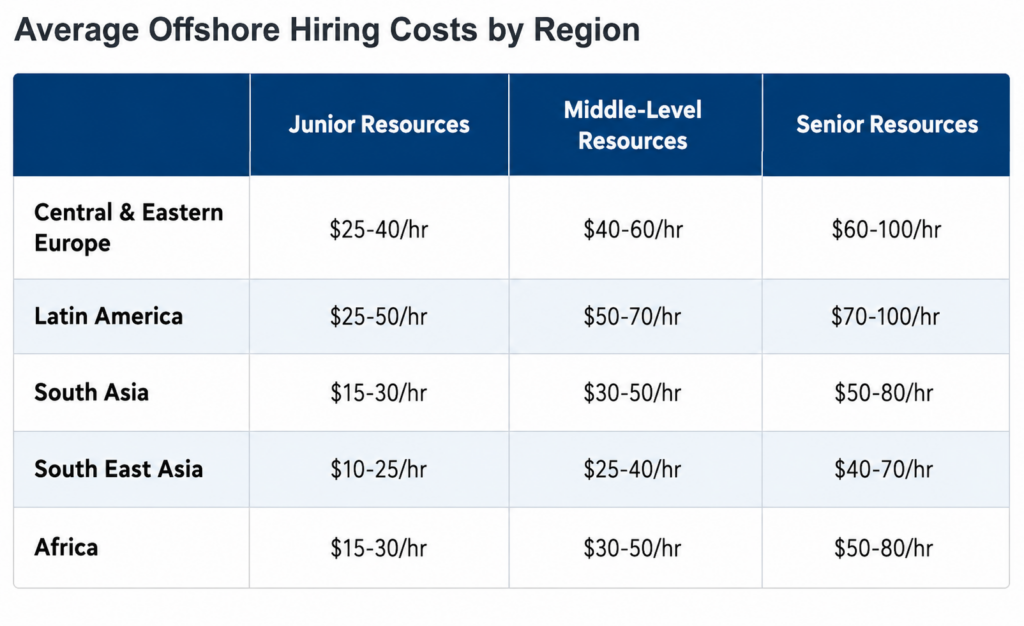
Average Offshore Hiring Costs by Region
Best Practices for Successful Offshore Staffing
Offshore staffing can deliver significant advantages for businesses, including lower operational costs, access to global talent, and improved productivity. However, achieving long-term success with offshore teams requires far more than simplifying hiring employees in another country.
Define Clear Hiring Goals
One of the most common offshore staffing mistakes is starting the hiring process without clearly defining business goals and performance expectations.
Before building an offshore team, companies should identify:
- The specific roles they need
- Required technical and soft skills
- Project timelines
- Budget expectations
- Reporting structures
- Key performance indicators
Businesses should also determine whether they need:
- Short-term project support
- Long-term dedicated teams
- Specialized technical experts
- Full offshore operational teams
Clear planning reduces hiring confusion and improves workforce alignment from the beginning.
It is also important to define communication expectations early. Offshore employees should understand:
- Working hours
- Meeting schedules
- Reporting procedures
- Collaboration workflows
- Project priorities
Choose the Right Offshore Staffing Partner
The success of offshore staffing often depends heavily on the quality of the staffing provider or recruitment partner involved.
Many businesses make the mistake of choosing offshore vendors based only on the lowest pricing. While affordability matters, poor-quality hiring partners can create long-term operational problems, including:
- Weak candidate quality
- High turnover
- Communication gaps
- Compliance issues
- Delayed project delivery
Businesses should carefully evaluate offshore staffing partners based on:
- Industry expertise
- Recruitment processes
- Talent screening methods
- Communication standards
- Security policies
- Compliance support
- Client reviews and case studies
A reliable offshore staffing partner should act as a strategic workforce extension rather than just a recruitment vendor.
Prioritize Strong Communication Systems
Communication is one of the most critical factors in offshore staffing success. Poor communication can lead to:
- Delayed projects
- Misunderstandings
- Reduced productivity
- Team frustration
- Quality issues
Businesses should establish clear communication frameworks before onboarding offshore employees.
Successful offshore teams typically use:
- Daily standup meetings
- Weekly progress reviews
- Shared documentation systems
- Real-time messaging platforms
- Centralized project management tools
Build Structured Onboarding Processes
Many offshore staffing failures happen because businesses rush onboarding or assume offshore employees will automatically adapt to internal workflows.
A structured onboarding process helps offshore employees understand:
- Company culture
- Business goals
- Team structures
- Project expectations
- Operational workflows
Effective onboarding should include:
- Training sessions
- Documentation access
- Role-specific guidance
- Security protocols
Companies should avoid overwhelming offshore employees with excessive information during the first few days. Instead, onboarding should be gradual, organized, and supported by continuous feedback.
Focus on Long-Term Retention
Employee retention has become increasingly important in offshore staffing. Skilled offshore professionals are in high demand globally, and high turnover can create major operational disruptions.
Replacing offshore employees often leads to:
- Recruitment expenses
- Lost productivity
- Delayed projects
- Knowledge gaps
- Increased onboarding costs
Final Words
Offshore employment has evolved into a strategic growth model that helps businesses access global talent, scale faster, and improve operational flexibility. Companies that prioritize communication, compliance, and long-term workforce integration are better positioned to build productive offshore teams that support innovation, efficiency, and sustainable business growth.